We share the light of Christ through acts of love, faith, and compassion — inspiring hearts to live the Gospel and serve with humility.
“Love one another as I have loved you.” — John 13:34‑35
Welcome to Amor Homily Archive
Welcome to the Homily Archive — a sacred space where words of faith, hope, and love continue to speak beyond the moment they were preached. Here, you’ll find reflections drawn from the Sunday readings and daily encounters with God’s Word — messages meant to touch hearts, guide lives, and deepen love for Christ.
Each homily is a seed of grace, inviting you to pause, listen, and let the Spirit renew your heart. Whether you seek inspiration for prayer, teaching, or quiet reflection, may these words remind you that God’s love is alive and active in every season of life.
“Let the Word dwell richly in your hearts, and let love lead you in all things.”


Homily: "Eighteenth Sunday in Ordinary Time: the Bread of Life that nourishes the soul — Jesus Himself."
The people in today’s Gospel followed Jesus because He had fed them with bread. Yet Jesus gently redirects their hunger: “Do not work for food that perishes, but for the food that endures to eternal life.”
We all hunger — not only for food, but for meaning, peace, and love. The world offers many kinds of bread: success, possessions, comfort, recognition. But these satisfy only for a moment. The Bread that lasts forever is Christ Himself — His Word, His presence, His love poured out in the Eucharist.
In the desert, God fed His people with manna. Today, He feeds us with His Son. The Eucharist is not just a ritual; it is the living reminder that God never abandons His people. Each time we receive Him, we are invited to become what we eat — to be bread for others, nourishment for the weary, hope for the broken.
Let us ask ourselves: do we seek the Bread of Life, or do we settle for crumbs that fade away? True fulfillment comes when we allow Christ to fill our emptiness and transform our hunger into compassion.
When I receive the Bread of Life, do I allow it to transform my heart — or do I walk away unchanged, still hungry for worldly things?
Homily: "Seventeenth Sunday in Ordinary Time: The Treasure of God’s Kingdom."
Today’s readings invite us to look deeply into our hearts and ask: What do I truly treasure?
In the first reading, Solomon could have asked for riches, fame, or victory over his enemies. Yet he asked for wisdom — a heart that listens. God was pleased because Solomon sought what mattered most: the ability to discern right from wrong and to lead with justice.
In the Gospel, Jesus speaks of the Kingdom of Heaven as a treasure hidden in a field and a pearl of great price. The person who finds it sells everything to possess it. This image challenges us to examine our priorities. What are we willing to give up to gain the treasure of God’s Kingdom?
The treasure is not material wealth or worldly success. It is the joy of knowing God, the peace of living in His grace, and the love that transforms our hearts. To find this treasure, we must be willing to let go of pride, selfishness, and the pursuit of temporary pleasures.
Saint Paul reminds us that “all things work for good for those who love God.” Even our struggles and sacrifices become part of the journey toward this treasure. When we live with faith, every moment — even the difficult ones — becomes meaningful.
Let us ask for Solomon’s wisdom: to recognize what truly matters and to choose God above all else. For when we seek His Kingdom first, everything else falls into place.
What treasure am I pursuing most in my life — worldly success or the peace that comes from God?
Homily: "Sixteenth Sunday in Ordinary Time: When God Waits, Grace Grows"
My dear brothers and sisters, Today’s readings invite us to reflect on the quiet, patient way God builds His Kingdom. The Book of Wisdom reminds us that God’s justice is gentle and His power is merciful. He does not destroy the sinner but gives time for repentance. Saint Paul tells us that the Spirit helps us in our weakness, praying for us when we do not know how to pray. And in the Gospel, Jesus speaks of seeds, yeast, and wheat — small, ordinary things that reveal extraordinary truths.
The parable of the weeds among the wheat is especially striking. The servants want to pull out the weeds immediately, but the master says, “Let them grow together until harvest.” God’s patience is not indifference; it is mercy. He sees the potential for goodness even in the midst of imperfection. He waits for hearts to change, for grace to take root.
In our lives, we often want quick results — instant holiness, instant answers, instant peace. But God’s Kingdom grows slowly, like a mustard seed becoming a tree or yeast transforming dough. His grace works quietly, often unseen, yet always alive.
Saint Augustine once said, “God is patient because He is eternal.” His timing is not ours. He waits because He loves. And when God waits, grace grows — in our hearts, in our families, in our communities.
So today, let us learn to wait with Him. Let us be patient with ourselves and with others. The weeds may still be there, but the wheat is growing too. Trust that God’s mercy is at work, even when life feels uncertain.
Do I allow God’s grace to grow patiently in me, or do I rush His work?
Homily: "Fifteenth Sunday in Ordinary Time: The Word That Gives Life."
Brothers and sisters,
Today we hear the Parable of the Sower, reminding us that God’s Word is always life‑giving, like rain that waters the earth, yet its fruitfulness depends on the soil of our hearts; some hearts are hardened like the path, others shallow like rocky ground, others distracted like thorny soil, but those who welcome the Word with openness and faith become good soil where hope and grace flourish abundantly; St. Paul assures us that even in suffering creation groans toward redemption, and so we are invited to cultivate our hearts—breaking pride, removing worries, deepening roots in prayer—so that God’s Word may bear fruit thirty, sixty, and a hundredfold, transforming our lives into a harvest of hope.
“What must I let go of so my heart can truly be good soil for God’s Word?”
Homily: "Fourteenth Sunday in Ordinary Time: Rest for the Weary Soul."
Brothers and sisters,
Jesus’ words today are simple yet life-changing: “Come to me, all you who labor and are burdened, and I will give you rest.”
Rest in Christ is not an escape from problems, but peace in the midst of them. Zechariah shows us a humble king who brings peace; the Psalm reminds us of God’s mercy; and Paul tells us the Spirit gives life. All point to one truth: God does not add weight to our shoulders — He lifts it.
When we surrender our pride and self-reliance, we discover His gentle yoke. Our burdens may remain, but they no longer crush us, because Christ carries them with us.
What burden am I still carrying alone, and am I ready to lay it down at the feet of Christ?
Homily: "Thirteenth Sunday in Ordinary Time: Generous hearts receive God’s life-giving grace."
The Shunammite woman’s hospitality to Elisha is a beautiful image of faith expressed through generosity. She did not expect a reward, yet God blessed her with new life—a son. In the same way, Saint Paul reminds us that through baptism, we are reborn in Christ; our faith welcomes divine life into our hearts.
Jesus, in the Gospel, calls us to love Him above all and to welcome others in His name. Every act of kindness, every gesture of welcome, becomes a channel of grace. True discipleship is not measured by words but by the warmth of our hearts and the openness of our hands.
When we welcome others, we welcome Christ Himself. And when we give even a cup of cold water to someone in need, we participate in God’s life-giving mission. Faith that welcomes life is faith that transforms ordinary moments into sacred encounters.
Do I welcome Christ through the people He sends into my life, even when it costs me comfort or convenience?
Homily: "Twelfth Sunday in Ordinary Time: Faith is stronger than fear."
The readings remind us that discipleship is not free from trials. In the Gospel (Matthew 10:26–33), Jesus tells His followers not to be afraid, for the Father cares even for the sparrows. This is a call to courage: to proclaim the truth openly, even when the world resists. Jeremiah’s lament (Jeremiah 20:10–13) shows the pain of being opposed, yet he clings to God as his mighty defender. Faith becomes stronger when tested, and fear loses its grip when we trust that God holds our lives in His hands.
Do I let fear silence my witness, or do I trust God enough to speak and live my faith boldly?
Homily: "Eleventh Sunday in Ordinary Time: God’s love is a gift received, and mission lived."
The readings this Sunday remind us of a profound truth: God’s love is never earned; it is always a gift. Israel was chosen not because of greatness or strength, but because of God’s mercy. His commandments were given not as burdens, but as a path to life — a sign of His covenant love. To be called His people is pure grace, a gift planted deep in the soil of our hearts.
Yet this gift is never meant to remain hidden or unused. It becomes a mission. To keep the commandments is not simply to obey rules, but to live as witnesses of God’s love in the world. Every act of forgiveness, every gesture of service, every moment of fidelity in trials becomes a testimony that His Kingdom is alive in us.
The growth of God’s Kingdom is often silent, unseen, and slow — like seeds sprouting beneath the soil. But it is real, and it transforms us. The challenge is to let His love move us from being receivers to being sharers, from gift to mission.
When we forgive those who hurt us, we show the mercy of God. When we serve the poor and the weak, we reveal His compassion. When we remain faithful in prayer and in keeping His commandments, we proclaim His covenant love. In these small, daily acts of fidelity, the Kingdom grows silently but powerfully.
God’s love is the seed; our mission is to nurture it. The commandments are not chains but pathways — guiding us to live in freedom, justice, and compassion. As Israel was called to be a holy nation, we too are called to be a people who embody God’s love in word and deed.
Do I live God’s commandments as mere obligation, or as a mission of love that silently grows His Kingdom in my daily life?
Homily: "Solemnity of the Corpus Christi: Food for a Resilient People."
The Solemnity of Corpus Christi invites us to contemplate the mystery of Christ’s abiding presence in the Eucharist. On this day, the Church proclaims that the Bread and Wine are not mere symbols, but the very Body and Blood of the Lord, given for the life of the world.
In the First Reading (Deuteronomy 8:2–3, 14–16), Israel was sustained by manna in the desert—a reminder that “man does not live on bread alone but on every word that comes from the mouth of God.” In our own deserts of poverty, illness, or uncertainty, the Eucharist becomes our manna, assuring us that God provides strength for the journey.
The Responsorial Psalm (Psalm 147) proclaims, “The Lord fills you with the finest wheat.” The psalm sings of God’s care, feeding His people with abundance. Each Communion is nourishment not only for the body but for the soul, strengthening us to face daily struggles with resilience.
In the Second Reading (1 Corinthians 10:16–17), St. Paul reminds us that “we, though many, are one body, for we all partake of the one bread.” The Eucharist is the sacrament of unity. In a fragmented world, it binds families, parishes, and communities together, teaching us to live not for ourselves but for one another.
The Gospel (John 6:51–58) reveals Jesus declaring, “I am the living bread that came down from heaven.” His flesh and blood are true food and drink, offering eternal life. In receiving Him, we are not only comforted but also sent forth to be “bread broken” and “wine poured out” for others—sharing compassion, mercy, and hope.
Corpus Christi is more than a feast; it is a call. In every Filipino family, the Eucharist brings hope in hardship, faith in uncertainty, and love that binds generations together. It teaches resilience: that even in trials, Christ is with us—nourishing, uniting, and sending us forth.
How can I become “bread for others”—a source of strength, hope, and love—in my family and community?
Homily: "Trinity Sunday: Love That Unites All Things."
On this Solemnity of the Most Holy Trinity, we are reminded that God is not solitary but a communion of love — Father, Son, and Holy Spirit — perfectly united in purpose and relationship. This divine unity is the model for every family. Just as the Father creates, the Son redeems, and the Spirit sanctifies, each member of the family is called to share, forgive, and nurture one another in love.
In our homes, unity does not mean uniformity but harmony — a reflection of the Triune God’s diversity in perfect oneness. When families pray together, forgive sincerely, and serve one another with humility, they mirror the life of the Trinity. Amid the noise of modern life and the crises that test our faith, the Trinity invites us to rediscover that love is the foundation of unity and prayer is the breath of peace.
Let our supplication echo the Trinity’s rhythm: “Father, teach us mercy; Son, lead us in truth; Spirit, bind us in love.” In this way, our families become living icons of divine communion — steadfast in faith, radiant in love, and strong in unity.
Homily: “PENTECOST: Born of Fire, Sent in Spirit”
Pentecost is the feast of fire and breath — the day the Holy Spirit descended upon the apostles, transforming fear into courage and silence into proclamation. It is the birthday of the Church, when diverse tongues were united in one voice of praise, and the Spirit gave gifts for the common good.
Mnemonic: PENTECOST
P – Peace of Christ fills fearful hearts (John 20:19–23).
E – Empowered by the Spirit with tongues of fire (Acts 2:1–11).
N – New creation renewed by God’s breath (Psalm 104).
T – Tongues united in one proclamation (Acts 2).
E – Every gift different, but one Spirit (1 Corinthians 12).
C – Community formed as one Body in Christ (1 Corinthians 12).
O – Obedience to mission: “As the Father sent me, so I send you” (John 20).
S – Spirit of truth guiding the Church (John 16:13).
T – Transformation from fear to courage (Acts 2).
Invitation
Beloved brothers and sisters, Pentecost is not only a memory of the past but a living reality today. The same Spirit who filled the apostles now longs to fill us — to renew our families, our parishes, and our communities with courage, unity, and love.
Call to Action
Open your heart to the Spirit’s fire.
Let His peace calm your fears.
Let His gifts strengthen your service.
Let His breath renew your mission.
Go forth as living witnesses of Christ, proclaiming His love in word and deed. Be a Pentecost today — a flame of faith, a breath of hope, and a voice of unity.


Homily: "Ascension: Lifted to Heaven, Sent to the World"
Today we celebrate the Ascension of Jesus — not His departure, but His exaltation. He ascends to the Father, not to leave us behind, but to lift our hearts toward heaven. The disciples gaze upward, yet the angels remind them: “Why are you standing there looking at the sky?” The mission continues on Earth.
In Acts 1:1–11, Jesus entrusts His disciples with the call to be witnesses “to the ends of the earth.” In Ephesians 1:17–23, Paul prays that we may know the hope and power of Christ who reigns above all. And in Matthew 28:16–20, the Risen Lord commissions us: “Go, therefore, and make disciples of all nations… I am with you always.”
The Ascension is both a promise and a sending forth. Christ’s glory is our destiny, and His Spirit is our strength. Heaven opens, not to remove Jesus from our world, but to draw our hearts upward — so that our lives may reflect His love here below.
To celebrate the Ascension is to live as people of mission and hope. We lift our eyes to heaven, but our hands must reach out to serve. Christ reigns above, yet He lives in every act of love we share.
Lord Jesus, as You ascend to the Father, lift our hearts to heaven. Fill us with Your Spirit, that we may bring Your light to the world and live as faithful witnesses of Your love. Amen.
Connect
Reach out for prayer, support, or guidance
Call
amor@evangelizanslove.org
+63 925 502 0090
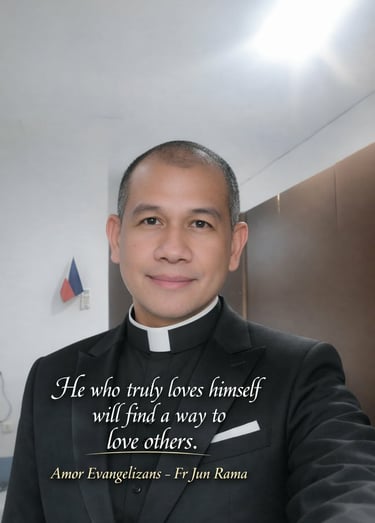
© 2026 AMOR EVANGELIZANS. All rights reserved and founded by Rev. Fr. Jacinto Ybañez Rama, Jr. on July 11, 2024.
All content—including texts, images, acronyms, reflections, and educational materials—is the intellectual and spiritual property of AMOR EVANGELIZANS. No part of this publication may be reproduced, distributed, or transmitted in any form or by any means (electronic, mechanical, photocopying, recording, or otherwise) without prior written permission, except for brief quotations used in spiritual or educational contexts with proper attribution.
“We let Christ be known, so that He may be loved.”